

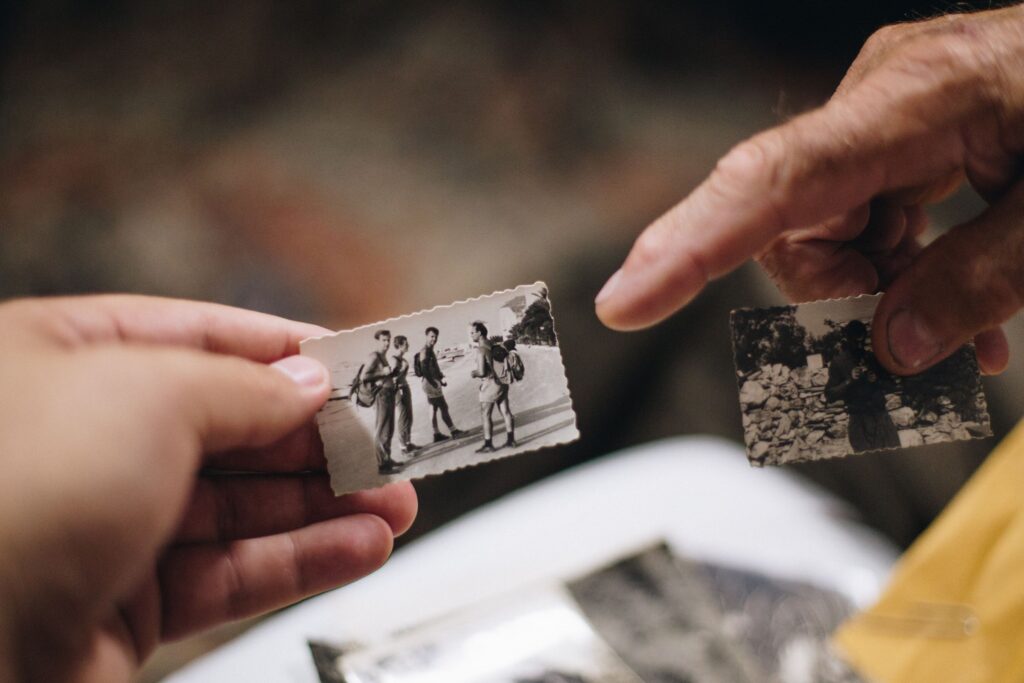
Put one old school photo on the kitchen table and ask what was happening that day. Mum remembers the photographer telling everyone not to blink. Her sister remembers that Mum had cut her own fringe with the kitchen scissors the night before. Mum denies this immediately, then laughs before she reaches the end of the sentence, which tells you nearly everything.
The photo has not changed. The story has.
This is collaborative family storytelling in its simplest form: more than one person invited into the same memory. One person remembers the event, another remembers the mood, and someone else knows who was standing just outside the frame. The youngest person in the room notices the detail everyone else stopped seeing years ago.
A family story is rarely a clean set of facts from one official narrator. It is voices, corrections, side notes and completely different versions of the same Sunday afternoon, and the good bits are usually in the corrections.
A photo holds the instant. A voice holds the person.
Families are already good at capturing things: the birthday photo, the blurry school concert video, seventeen nearly identical shots of everyone beside the cake. What those files rarely keep is the conversation around them. Who made the cake, and why does it lean to the left? Why is Grandad wearing a paper crown in every photo except one?
A photograph gives the story somewhere to start. Voice gives it movement: the pause before somebody answers, the laugh that arrives before the punchline, and the interruption from across the room because the story is becoming wildly inaccurate.
Voice carries personality, too. Your dad might tell every story as if it is a courtroom argument. Your aunt may begin with “That is not what happened” before offering a version that is somehow even less reliable. Write it down and the facts survive. Record it and the courtroom delivery survives as well, which is how you preserve family voices and not only family facts. Got a shoebox of prints? Start with the stories behind old family photos.
Different versions are not a problem to solve
There is a temptation to tidy family stories. We want the correct year, the correct street and one agreed explanation for how the red biscuit tin ended up with a dent in the lid. Accuracy matters when a fact matters. But not every difference needs a referee, and sometimes the disagreement is the story.
One brother remembers a camping trip as three days of rain and a leaking tent. The other remembers it as the greatest adventure of his childhood. Their mother remembers trying to dry six pairs of socks over a tiny stove while both boys claimed they were helping.
All three versions can be true. Collaborative storytelling lets each person add what they saw, felt and noticed, so the result sounds like a family, not a report.
One person should not have to carry the whole family story
Most families have a memory keeper. They know the names of distant cousins, the recipe that was never written down and which box holds the good photographs. They are the person everyone calls when somebody asks, “What year was that?” It is a generous role, and a lot of family history for one person to hold.
Shared, the load gets lighter: one person begins with a photo, another adds a voice recording, someone else corrects the name on the back. In A Moment With, a story holds the whole thing (“Nan’s Kitchen”, say), chapters can each hold a period, a person or a theme, and each moment is one piece in whatever form suits it: a photo, a video, a voice note or a few written lines. There is a fuller tour in how A Moment With works.
None of it needs finishing in one weekend; a story stays open for whenever another detail turns up. For a gentle rhythm, here is how to record family stories without making it a project.
What collaborative family storytelling looks like now
Family storytelling is often described as something we do for the future. That is only part of it. Asking for another person’s version changes the conversation you are having today. A photo sent to a sibling can begin with “Do you remember this?” and end somewhere nobody expected. A parent answers a simple question, then remembers the neighbour, the song on the radio or the job they nearly took.
Those conversations belong to the people having them, not to an audience. In A Moment With there is no public feed, nothing is public unless you choose it, and you decide who sees each story. No followers, no ranking algorithm and no pressure to make the story neat enough for strangers. Just the right people, adding what they know.
How to begin a shared family story
Do not begin by asking everyone to document their life. Choose one moment that already has energy around it: the photo that always starts an argument about where it was taken, the recipe card with one missing instruction, or the object nobody will throw away. Then ask one specific question, the kind with a scene already inside it:
- “What happened just before this photo?”
- “Why did we always use this biscuit tin?”
- “Who taught you to make this?”
- “Who else would tell this story differently?”
They work as questions to ask your parents over the phone, too, and there is a longer list in questions to ask your grandparents (and parents). Once you have your question, start a story in A Moment With and add the first moment: the photo, voice note, video or written detail that opens it.
Then bring in one person who can add something you cannot. Send them a Request a Moment link: they answer in their phone’s browser by voice, video, photo or a few written lines (you choose which), with no app or account, and you see each answer before deciding whether to add it to the story. You are not asking them to approve your version. You are giving the story another side.
On the web, Request a Moment is a button on the story page; on the phone, it is the Request tile in the story’s people row. The free plan includes 5 requests in total, and Premium and Legacy+ let you send as many as you like. If someone will keep adding, invite them to the story as an Editor instead: Invite people on the web, or the Add tile on the phone. Editors need an A Moment With account (a free one is fine); people answering a request do not. Here is how Request a Moment works from both ends of the link.
Let the story stay human
A family story does not need perfect audio, a formal interview or a narrator who remembers every date. It needs the laugh that gives away the ending, the correction from the next room, and the small contradiction that shows how differently two people lived the same day. That is why A Moment With is built around voices and more than one storyteller: a camera roll keeps the files, not the argument about them.
A photo can show the table.
One voice can explain why everyone was there.
Another can tell you what happened when the camera was put down.
That is the story, and it is rarely one person’s to tell. Start with one photo, one question and one other voice.
Prefer the app? Get A Moment With on the App Store or Google Play.