Ask your grandparents to “tell me about your life” and you’ll get the summary. Born here, moved there, married your grandmother, thirty-one years at the bank. It’s all true, and it reads like a CV. The question is so big that the only sensible answer is the short version.
The best questions to ask your grandparents are smaller. They point at one place, one person or one first time, and a scene comes with them. Ask Pop what school was like and you’ll hear about the walk (long, uphill, both ways). Ask him who sat next to him and you might get the boy who kept a ferret in his schoolbag, and what the teacher did about it.
Below are questions that tend to get a real story, grouped into the five chapters A Moment With suggests for a life story. They double as questions to ask your parents about their childhood, and they work just as well on an aunt, or the neighbour who has been on your street since 1962.
What makes good questions to ask your grandparents
The ones that work usually have one of three things in them.
- A place. “What was your street like when you were my age?” puts them back on the footpath, noticing who lived next door.
- A person. “Who was your best friend at school?” comes with a name, and names come with stories attached.
- A first time. First job, first pay, first car, first time they saw the sea. Firsts get remembered in detail because everything about them was new.
Compare “What was your childhood like?” with “What did a Saturday look like when you were ten?” The first asks for a verdict. The second asks for a morning, and they can picture it.
How to use this list
Most lists of family history interview questions run to fifty. Pick one or two. Working through the whole list turns a cuppa into a deposition, and the good answers usually turn up around the second or third question anyway, once everyone has forgotten the phone is on the table.
The real work is in the follow-ups. Keep three handy:
- “What happened next?”
- “Who else was there?”
- “Why do you think you still remember that?”
That last one is the best of the lot, because it turns an anecdote into the reason it mattered. And let them wander. If a question about their first job becomes ten minutes on a dog called Rusty, that was the story they wanted to tell.
Early life
An easy place to start. Everyone had a childhood, and nobody had to be anything yet.
- What was your neighbourhood like when you were my age? Who lived next door?
- What was a normal day like when you were nine or ten?
- Who was your best friend growing up, and what happened to them?
- What did you get up to on school holidays, and how far from home were you allowed to go?
- Was there a teacher, a neighbour or someone else who saw something in you back then?
Expect at least one story involving a billycart, a creek or both.
Family and relationships
- What were your parents like? Not as parents, as people.
- How did you and Nan meet? Who made the first move?
- Is there a family saying nobody can explain? Where did it come from?
- What did your parents do that you swore you’d never do? How did that go?
Ask Nan and Pop the “how did you meet” question separately and compare notes later. The two versions rarely match, and both are worth keeping. The last question almost always gets a laugh, usually followed by a confession.
Work and purpose
People who would skip “tell me about your career” will happily spend an hour on their first job.
- What was your first job, and what did you do with your first pay?
- What did you want to be when you were a kid? What happened to that plan?
- Was there a job you nearly took? Where do you think you’d be now?
- What’s something you made or built that you’re quietly proud of?
The job they nearly took is the sleeper. It’s the other life, and most people have thought about it more than they let on.
Defining moments
This chapter holds the heavier questions, so make them optional. Say up front that they can skip anything, and mean it. Some people want to talk about the hard year; some would rather tell you about the fishing trip. Both belong in the story.
- Was there a day that split your life into before and after?
- What was the best day of your life, and why that day?
- When did you have to be braver than you felt?
“Why that day” does the heavy lifting. The expected answer is a wedding or a birth, and sometimes it is. Sometimes it’s an ordinary Sunday nobody else remembers, which tells you more about them than the wedding would.
What I want you to know
This chapter often fills itself once the others have warmed everyone up. Don’t tack it onto the end of a long afternoon; it can have a visit of its own.
- What do you wish someone had told you when you were young?
- What should the family never forget about where we come from?
- Is there something you’d like the grandkids to know that they wouldn’t think to ask?
How to record your grandparents’ stories without making it an interview
In person, keep it low-key. Ask if they mind you recording (“so I don’t have to remember it all”), put the phone on the table, then stop looking at it. In the A Moment With app, the Voice Note tile records the conversation as a moment and lets you file it in the right story and chapter, so it doesn’t end up in a voice memo app between a shopping list and a parking reminder. Voice is often a better bet than video: nobody worries about their hair, and the phone is easier to forget. Leave the app open on the recording screen while you talk, and if your phone usually locks itself after a minute, give it a longer screen timeout for the afternoon.
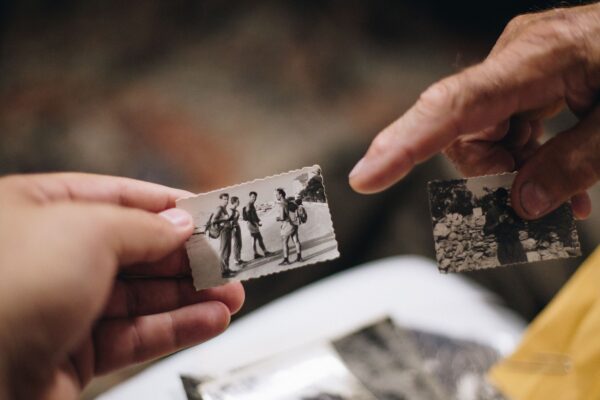
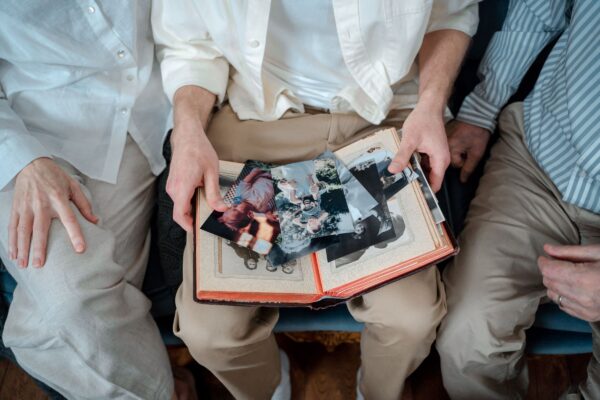
Keep the tangents. Record in a few shorter goes if that’s easier, and put each one in the chapter it belongs to. If there’s a shoebox of old photos, bring one along. A photo is a question that asks itself, and here’s how to keep the story with the photo.
At a distance, send one question rather than saving it for the next visit. Request a Moment turns a question into a link. They open it on their phone and answer by voice, video, photo or a few written lines in the browser, with no app to install and no account to make. You see each answer first and choose whether to add it to your story, and it’s credited to whatever name they type. A personal link takes recordings of up to five minutes, which is plenty for a good story, if not quite enough for the 1977 grand final and the replay. Here’s how to send one, step by step.
Where the answers live
Start a new story in A Moment With, choose the Memory category and leave Use suggested chapter structure switched on. The story starts with five chapters: Early Life, Family & Relationships, Work & Purpose, Defining Moments and What I Want You to Know. They’re the same five this list follows, which is not a coincidence. Each chapter comes with its own suggested questions, so if your mind goes blank halfway through a visit, there’s one waiting. A few of the questions above come from those lists.
Then let the rest of the family add their versions. Invite a sibling or cousin to the story as an Editor and they can add chapters and moments of their own. They’ll need an A Moment With account, and the free plan is fine. Mum’s memory of the farm will not match her brother’s. Keep both.
If you’d like this to become a regular thing rather than one big afternoon, here’s how to start a family storytelling habit that sticks. And if you’re looking for questions to ask elderly parents or grandparents in aged care, these travel well, and here are a few more ideas for visits.
A Moment With is free to start. The free plan includes up to 5 stories and 5 free requests with Request a Moment, on iPhone, Android and the web. Pick one question, put the kettle on and see where it goes. Worst case, you learn a great deal about the walk to school.
Prefer the app? Get A Moment With on the App Store or Google Play.