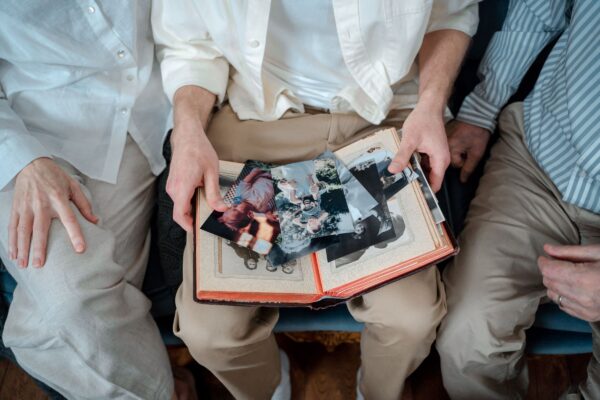
Most families do not need convincing that their stories matter. They need a way to begin that does not sound like another job.
The big plan usually appears after a birthday lunch or a story nobody has heard before. Someone says, “We really should record all of this.” Everyone agrees. Then the dishes are cleared, Monday arrives and “all of this” becomes too large to touch.
If you are working out how to record family stories, the answer is not a better spreadsheet or a free weekend. It is a family storytelling habit small enough to survive a busy week: one question after Sunday lunch, one voice note on the school run, one photo with the story added while everyone still remembers it. The aim is not to finish a family history. It is to keep adding to one.
Make the first step almost too easy
If the first step is “record Mum’s life story”, it will keep moving to next month. If the first step is “ask Mum why she never measures the flour”, you can do it while she is making scones. Specific questions are easier to answer because they already contain a scene, and they feel less formal for the person being recorded.
The best family story ideas are usually already happening:
- Ask for the story behind the meal everyone requests.
- Record the explanation of an old family saying.
- Choose one photo that always gets passed around.
- Ask what the first family car was really like.
- Capture the story that comes out every Christmas, slightly longer each year.
Five useful minutes is better than waiting for a perfect hour.
Attach the habit to something your family already does
Habits are easier to repeat with a natural cue, and you probably do not need a new family ritual to get one. The first Sunday of the month, a regular drive, a weekly phone call or the ten minutes after dinner when nobody has stood up yet will all do.
The cue should feel ordinary. “When Dad tells the same story again, we record this version” is more realistic than “every family member completes a monthly interview”. The point is not discipline. It is noticing the opportunities that are already there.
Choose one question, not twenty
A long list of questions can make a relaxed conversation feel like homework. Ask one thing you genuinely want to know, then keep a few small follow-ups in your back pocket:
- “What happened next?”
- “Who else was there?”
- “Why do you still remember that?”
- “What would your sister say happened?”
Let the answer wander. The detail you did not plan for is often the part the family repeats later. For starting points, try this list of questions to ask your grandparents, then pick one or two, not the whole page.
What if your family is not ready for a big conversation?
Some people love telling stories. Others go quiet as soon as the word “interview” appears. For them, start beside the story instead of asking for a life summary: cook the recipe together, look through three photographs, ask about the object on the shelf, or ring after the footy and ask why the result mattered so much.
You can also go first. Record what you remember about a family ritual, then ask someone to correct the part you have wrong; a familiar disagreement is easier than a formal invitation to share. Either way, ask before you press record, and mean it when you say they can change their mind. The habit works when taking part feels welcome, not required.
Keep ordinary moments, not only milestones
Birthdays, weddings and anniversaries are obvious story prompts, but not the only moments worth keeping. A family is also made of the Saturday pancakes that are never the same shape, the phrase Mum says when she cannot find her glasses and the voice note your brother sends whenever his team loses. And the things a four-year-old says change faster than anyone can write them down.
Milestones tell us what happened. Ordinary details tell us what life felt like, and a good habit makes room for both.
Let different people add their version
One person often becomes the keeper of the photos and the family knowledge, but no one person remembers everything. When a story involves someone else, invite them in: the cousin who was there, the friend who took the photo, the sibling who is certain your ending is wrong. Family stories are better when everyone gets a say, and the disagreements are half the fun.
In A Moment With there are two ways to do that. If someone will keep adding, invite them to the story as an Editor, using Invite people on the web or the Add tile in the story’s people row on the phone. Editors can add chapters and moments of their own; they need an A Moment With account, and the free plan is fine.
If you only want their side of one story, send a Request a Moment link instead. They answer in their phone’s browser by voice, video, photo or a few written lines (whichever you offer), with no app and no account, and the answer is credited to the name they type. You see each answer first and decide whether to add it to the story. Here is how Request a Moment works, step by step.
Either way, the habit gets lighter. You begin with what you know, and nobody has to be responsible for the complete family record.
Give someone permission to be the noticer
A habit often starts because one person begins noticing what the family would normally let pass. They hear a familiar story and reach for the phone. They ask who is in the photo before the album goes back in the cupboard.
That does not make them the family historian. It makes them the person who begins, and everyone else can add names, corrections and their own version later. If that person is you, keep the invitation light. “I loved that story. Can we keep it?” lands very differently from announcing that everyone is now taking part in a family history project.
Keep it findable
Family stories are often captured in places that are hard to return to. A voice note sits in a message thread. A caption lives under a social post. A video disappears into a camera roll between screenshots and receipts.
If you want to preserve family history rather than just collect files, add enough context for someone else to recognise each story: name the people, explain the occasion, and keep the recording close to the photo that prompted it. In A Moment With, each photo, video, voice note or written note is its own moment with room for a caption, a date and a place, filed in a story or chapter instead of a camera roll. The voice note about the wedding photo can sit right beside the photo. If you want a first project, old family photos are an easy one.
Try this four-week rhythm
You do not need a content calendar at home. This just removes the pressure of deciding what to capture next.
- Week one: the story behind a photo.
- Week two: a voice you hear in ordinary life.
- Week three: an object, recipe or place with a family story.
- Week four: another person’s version of something already recorded.
Then start again when it feels natural. Skip a week without guilt, and add two moments when the family is together. A living story should fit around life, not compete with it. (If week four becomes a Request a Moment link, note that the free plan includes five requests in total; Premium and Legacy+ allow as many as you like.)
How to record family stories in your first five minutes
Open a photo that already makes someone talk. Ask one question and, with their permission, record the answer. In the A Moment With app, the Voice Note tile records straight into the story or chapter you pick, or into Drafts if you have not decided where it belongs yet. Add the person’s name and one line about why the story matters.
Stop there.
You have not failed to finish the family history. You have started it in a form you can actually continue.
Prefer the app? Get A Moment With on the App Store or Google Play.